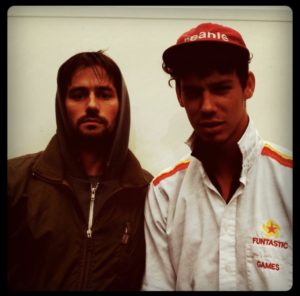
Ben Raemers was the sweetest, funnest kid I ever toured with. I only traveled with Ben a couple of times, first through Europe and then through the Pacific North West. Now, in light of his recent death, I realize that there was a subtle anxiety in him that only in hindsight I see was the surface ripple of something profoundly painful. Having experienced episodes of darkness in my own life, I can’t help but interpret that as an indication that somewhere deep inside him was a dark, agonizing, Mariana Trench, from which he was desperately trying to escape. That constant struggle is exhausting but I remain convinced that there are concrete methods out there with which we can defuse these mental short-circuits — these false narratives that get stuck on loop in our heads. And, I have to say, I feel lucky that although I have suffered through periods of depression at times in my life, I have each time been able to find that invisible side-door through which to escape back onto a more optimistic path through this labyrinth we call life; and I have not been stuck in the awful, crippling loop of long-term or truly chronic depression.
The spark to start writing this post came when I picked up my old notebook from the weeks that directly followed my own sister’s suicide back in 2011. It’s a small 6″x 6″ brown craft-card-bound pad that I kept with me in Scotland when I was back there for the funeral. From the opening few pages I can see that I had been reading a book called The Philosopher and the Wolf by Mark Rowland. One of the passages I had noted down relates to the human condition and goes as follows: “…our uniqueness [as humans] lies simply in the fact that we tell these stories — and, what’s more, we can actually get ourselves to believe them. If I wanted a one-sentence definition of human beings, this would do: humans are the animals that believe the stories they tell about themselves. Humans are credulous animals.”
Now in 2019, for the last few weeks I’ve had a book by my bed that I’ve been dipping into here and there called Waking Up, Alive by Richard Heckler. It’s about the road to recovery after a suicide attempt. In it Heckler walks us through a number of case studies from his work as a Psychologist and Counselor. The quote that stood out to me this morning is in the story of Teresa, a soft-spoken mother of two Nurse, who lost her biological father and was then horrifically abused by her stepfather. Over time her brain’s survival mechanism was to construct a story, a narrative in which her real father could provide her solace from the afterlife and that if she died she would surely be reconnected with him.
“Slowly but progressively, Teresa withdrew from life by entertaining the possibility of her death. She had constructed and nourished a lethal equation: that in death there is solace and connection; in life, there is only despair.”
In retrospect, I now again recall my own sister, Katrina, talking wholeheartedly with clear conviction about her best friend Laura who passed a couple of years earlier due to complications of pneumonia and left Katrina utterly devastated. “Aye, that’s Laura right there, that bright one,” Katrina would say gazing up at the night sky as we walked through Westburn Park on a summer night in 2009. In her head Laura was still “up there” watching, smiling, compassionately waiting for them to reunite. I thought it best that I didn’t tell her that was actually the planet Saturn. Now I’m not sure if that was best after all.
To bring it back to Ben, the fact is that I didn’t know him well enough. Like I said, I only traveled with him twice before we were both again off on different paths. Him with new sponsors and a bright few years ahead of him as a well-loved and respected Pro Skater; and me to figure out what life after pro-skateboarding looks like. Since then I’ve thought a lot about the subject of depression and its horrific worst-case conclusion. To bring hope back into the arena, I am more and more convinced that education about the root causes of depression is a critical factor in reducing suicide. At least I hope it is. The thing about depression is that it feels so all encompassing and overwhelming. It’s feels enormous and insurmountable when you are in it, but I will continue to believe — until I’m categorically proven otherwise — that knowledge and understanding is a tool that can help move things in a positive direction. To be lost in the dark is a different feeling than being lost with a map. The counterpoint that immediately springs to mind is that depression has a tendency to make us forget to look at the map. That’s where the knowledge and education part comes in. The more understanding we all have about this stuff — whether we’re going through it or beginning to notice a friend going through it — the more chance we have to catch it…I think. I hope.
If you are struggling and need immediate help here are some first response resources:
US/UK: Crisis Text Line https://www.crisistextline.org
Aust: Lifeline https://www.lifeline.org.au/
Comments
3 responses to “Ben Raemers: Some thoughts on depression and its worst-case conclusion”
Great insight Mr. Rattray. As someone who is fortunate enough not to have to deal significant MH issues myself, I find it particularly mysterious when someone so apparently full of life and joy such as Mr. Raemers succomb to this disease. I agree that hope lies in futher education and empathy. ❤️
Very well said, Mr. Rattray. I immediately began reviewing Durkheim’s “Le Suicide” (having recently read it for a sociology course) upon the unfortunate discovery of Ben’s passing. Not only do we need to consider, as you mentioned, better education about depression, but also the concept of social integration and a sense of belonging to society. I wonder if maybe he never really felt like he was where he wanted to be. Or maybe he never had those connections that we, as a social species, thrive on. For the sake of Ben, I won’t theorize further, as we will truly never know what brought him to his decision, and of course, you actually met him. So my theories could be baseless. But I admired Ben’s spirit and skating. Thank you for taking the time to write these words and suggest a course of action we could all take to help those in need around us.
You pretty much nailed it. Although everyone deals with their darkness in their own way and no two cases are ever exactly the same, the more you know about how to move forward the better chance you have of taking that next step.